Overview
The circle method has its genesis in a paper of Hardy and Ramanujan (see [Hardy 1])in 1918concernedwiththepartitionfunction andtheproblemofrep- resenting numbers as sums ofsquares. Later, in a series of papers beginning in 1920entitled "some problems of'partitio numerorum''', Hardy and Littlewood (see [Hardy 1]) created and developed systematically a new analytic method, the circle method in additive number theory. The most famous problems in ad- ditive number theory, namely Waring's problem and Goldbach's problem, are treated in their papers. The circle method is also called the Hardy-Littlewood method. Waring's problem may be described as follows: For every integer k 2 2, there is a number s= s( k) such that every positive integer N is representable as (1) where Xi arenon-negative integers. This assertion wasfirst proved by Hilbert [1] in 1909. Using their powerful circle method, Hardy and Littlewood obtained a deeper result on Waring's problem. They established an asymptotic formula for rs(N), the number of representations of N in the form (1), namely k 1 provided that 8 2 (k - 2)2 - +5. Here
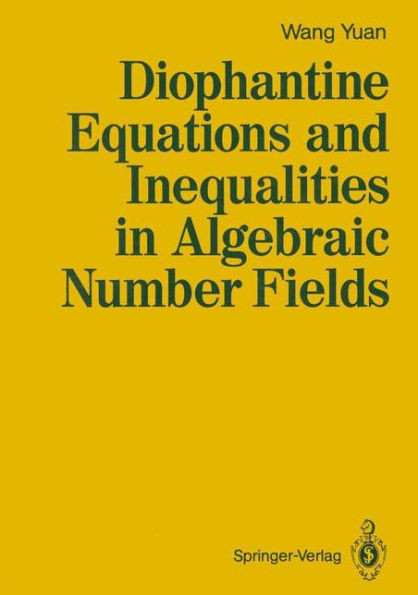
- | Author: Yuan Wang
- | Publisher: Springer
- | Publication Date: Oct 18, 2012
- | Number of Pages: 170 pages
- | Binding: Paperback or Softback
- | ISBN-10: 3642634893
- | ISBN-13: 9783642634895