
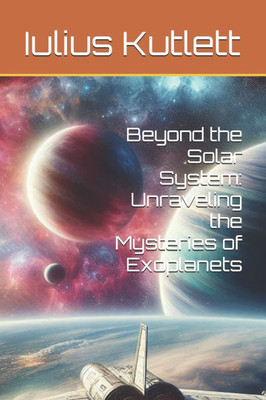
Beyond the Solar System: Unraveling the Mysteries of Exoplanets
Independently published
ISBN13:
9798316259960
$14.07
(No reviews yet)

Write a Review
Independently published
Beyond the Solar System: Unraveling the Mysteries of Exoplanets
Exoplanets, or extrasolar planets, are celestial bodies that orbit stars outside our solar system. The term encompasses a wide variety of planets, ranging from gas giants like Jupiter to terrestrial planets similar to Earth. The discovery of these worlds has revolutionized our understanding of planetary systems and has opened new avenues for research into the potential for extraterrestrial life. The definition of exoplanets, while straightforward, is essential for the context of ongoing research and exploration, as it sets the stage for how these distant worlds are studied and categorized. The first confirmed detection of an exoplanet occurred in 1992, marking a significant milestone in astronomy. Since then, thousands of exoplanets have been identified, each presenting unique characteristics that challenge our existing models of planetary formation and evolution. Exoplanets are typically classified based on their size, composition, and distance from their host stars. This classification is crucial for understanding their potential habitability and the environmental conditions that may exist on their surfaces or in their atmospheres. Methods of exoplanet detection have evolved considerably over the past few decades, employing various techniques such as the transit method, radial velocity method, and direct imaging. The transit method, which involves observing periodic dimming of a star's light as a planet passes in front of it, has proven to be one of the most effective ways to identify exoplanets. Each detection method contributes unique data that helps refine our understanding of exoplanet characteristics and distributions within the galaxy, providing vital information for comparative planetology. Habitability criteria play a critical role in the study of exoplanets, particularly in the search for another Earth. Factors such as a planet's distance from its star, the type of star it orbits, and its atmospheric composition are vital for assessing its potential to support life. The concept of the "habitable zone," where conditions may allow for liquid water to exist, is central to this discussion. As we refine our definitions and criteria for habitability, the distinction between potentially habitable exoplanets and those that are unlikely to support life becomes increasingly nuanced. The role of space telescopes in exoplanet research cannot be overstated. Instruments like the Kepler Space Telescope and the upcoming James Webb Space Telescope are designed to enhance our ability to detect and characterize exoplanets. These telescopes provide high-resolution data that allow scientists to analyze the atmospheres of exoplanets, revealing their composition and dynamics. Such insights are crucial for understanding not only the planets themselves but also their potential to harbor life. As technology continues to advance, the definition and understanding of exoplanets will evolve, propelling us further into the mysteries beyond our solar system.
- | Author: Iulius Caesar Kutlett
- | Publisher: Independently Published
- | Publication Date: Mar 31, 2025
- | Number of Pages: 00062 pages
- | Binding: Paperback or Softback
- | ISBN-10: NA
- | ISBN-13: 9798316259960
- Author:
- Iulius Caesar Kutlett
- Publisher:
- Independently Published
- Publication Date:
- Mar 31, 2025
- Number of pages:
- 00062 pages
- Binding:
- Paperback or Softback
- ISBN-10:
- NA
- ISBN-13:
- 9798316259960
-
-
Sale
-